I started this newsletter as an alternative to social media for sharing my art, which I felt never presented my work in an ideal format. Sending out this newsletter has been a long time coming, and to be honest, is more intimidating than making an IG post, where I know my contribution is just feed fodder. So let your continuation with the rest of this post be a conscious choice to engage a little deeper. In any case, thank you for being here and being interested in what I have to share, even if they’re not masterpieces.
For the past year I’ve been working three jobs – not simultaneously, but sporadically – strategically slotting in whatever fits into the week depending on the tasks and their due dates. I want to blame my current existential crisis of not being a real artist on not having time to work on personal art, but in the spare moments I had to reflect, I’ve pieced together an unsettling truth. I realized it’s actually easier to work for others – to hide behind the nobility of serving a bigger cause (and to pay the bills); it takes more courage and grit to face my own blank canvas.
“Since I have so little time to do anything, the next artwork I make must be a masterpiece to make it all worthwhile!” The pressure to create anything under this mentality causes so much friction that I produce nothing – not even a little sketch, which is all I have energy for by the end of the day. Not to mention that the connection to my imagination has already atrophied from disuse. To counter this, I’ve returned to real paints and paper – specifically, watercolor because proficiency in this medium requires speed and repetition. Here are some of my practice paintings that are palatable.
My comfort zone has always been landscapes – I can get away with a lot by just painting impressions of things. The shapes can be vague and the painting will still make sense if the composition and perspective work.
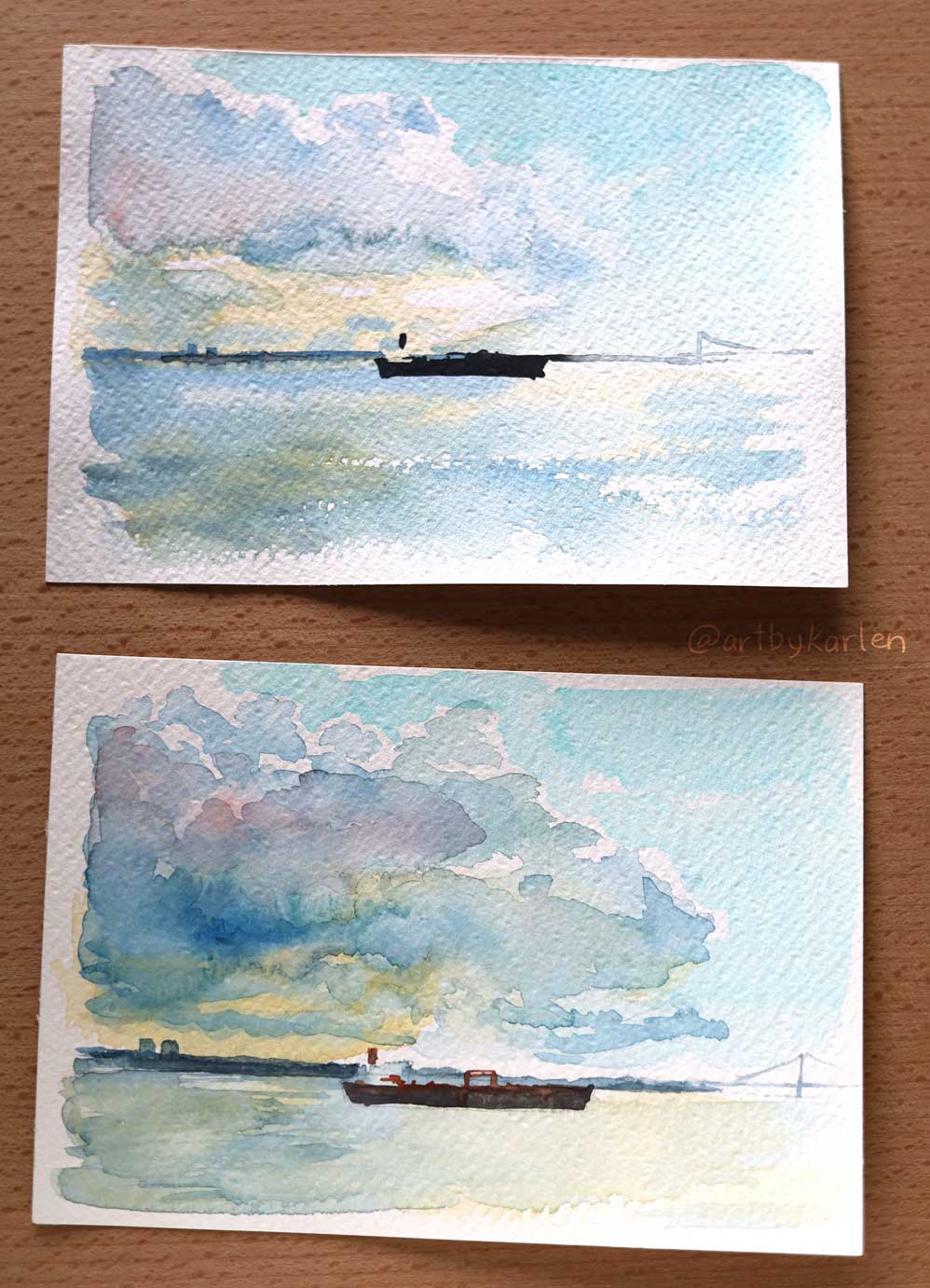
Here are two 4″ x 6″ sketches that I did twice because while the clouds and water came out well on the first, I didn’t like boat and the placement of the horizon. But on the second attempt, the sky got too dark, while the boat is more refined. I have always struggled to control water flow and intensity of the colors. Maybe painting the third one would have been perfect? We will never know.
I then decided to really learn to watercolor, I’d have paint subjects that require precision. I will try painting human faces – I can’t fudge that because we are so used to seeing other humans that it’s painfully obvious if something is off. So I started off by studying a model of a skull, which I set under a lamp.
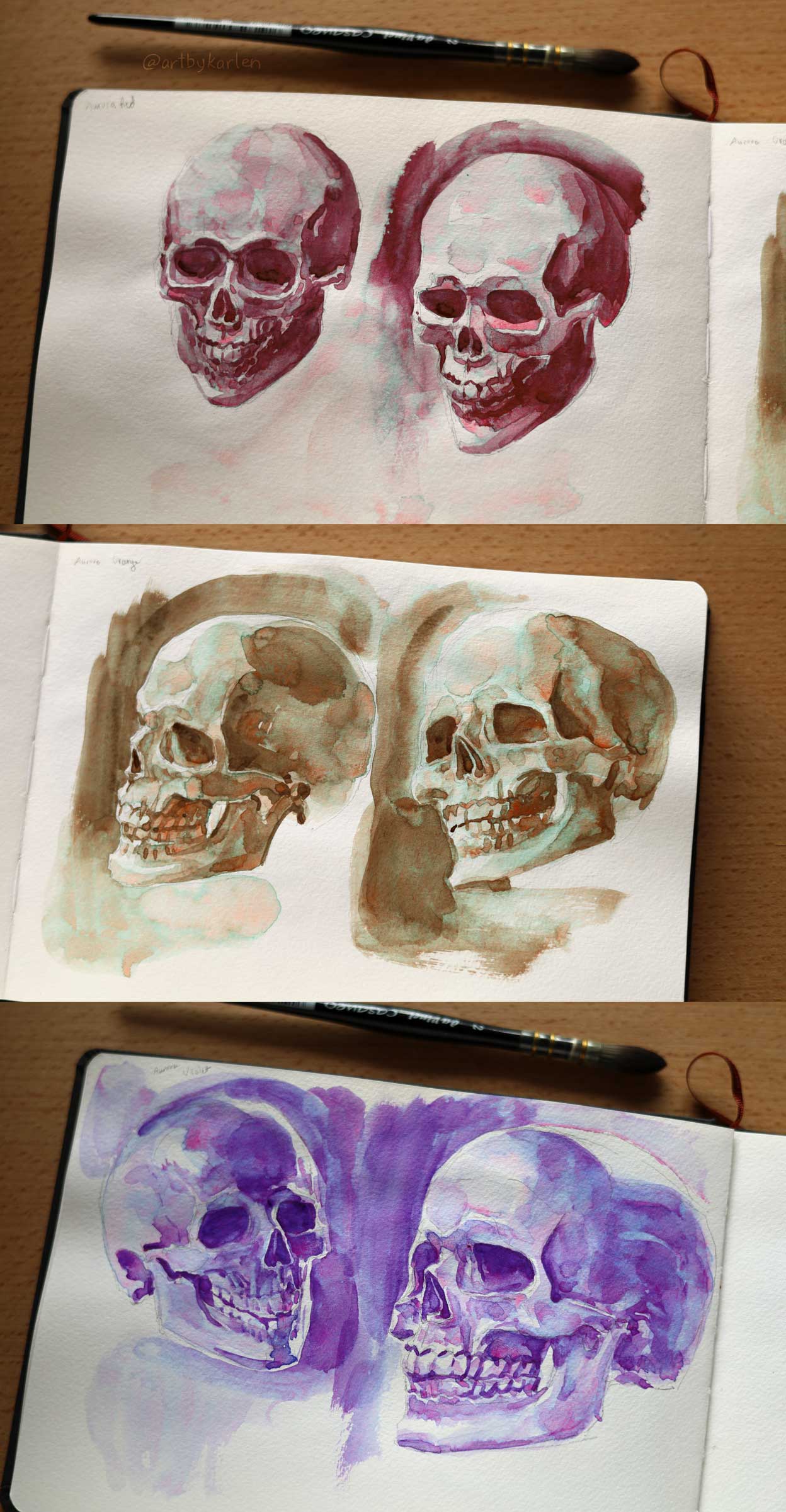
These studies were done in a Hahnemühle 5″ x 8″ watercolor sketchbook with the Kuretake Gansai Tambi Granulating paint set (“granulating” means the colors separate when water is added). I got these paints intending to use them for value studies because I can’t control what the colors will do – only how dark or light they’ll get. The striking color effects are a bonus bit of flair. I included the ugly sketch to show the jump in understanding of paint application between the first set of skulls, which were done in one sitting. The skulls behind these pages are grimacingly awful so I will spare you the sight of those.
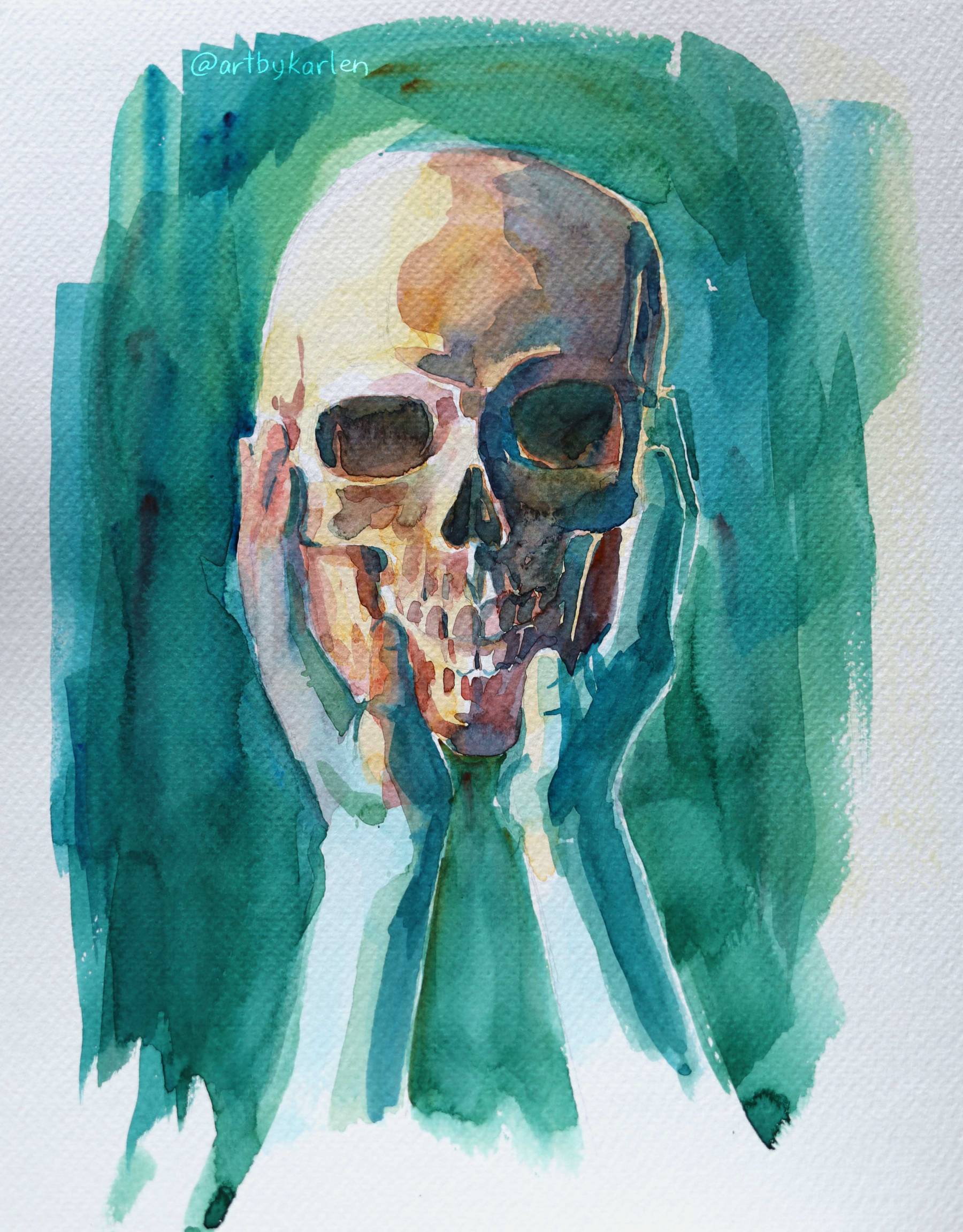
Several skulls later I tried making a concept out of the studies. I used regular watercolors on a larger sheet of 9″ x 12″ paper. One would think it’d be easier to paint bigger but I struggled to keep the paint wet across sections to achieve smooth color transitions. If I were to paint this again (for the third time), I’d use a more limited pallet and spend more time refining the drawing.
Recently I did a full illustration in watercolor, thinking I might be able to pull off something decent only to be humbled by the end of working on it for weeks. It was clear I needed much more practice, so I filled pages with more face studies, occasionally daring to try on a larger sheet.

Everyone says using the best watercolor paper is half the battle, and that practicing on crappier paper will hinder progress, but I still can’t justify using the premium stuff yet. In my pursuits, I stumbled upon this book in the library – Breaking the Rules of Watercolor by Burt Silverman, who as implied by the title developed his own unconventional way of painting, similar to how he worked with oils.
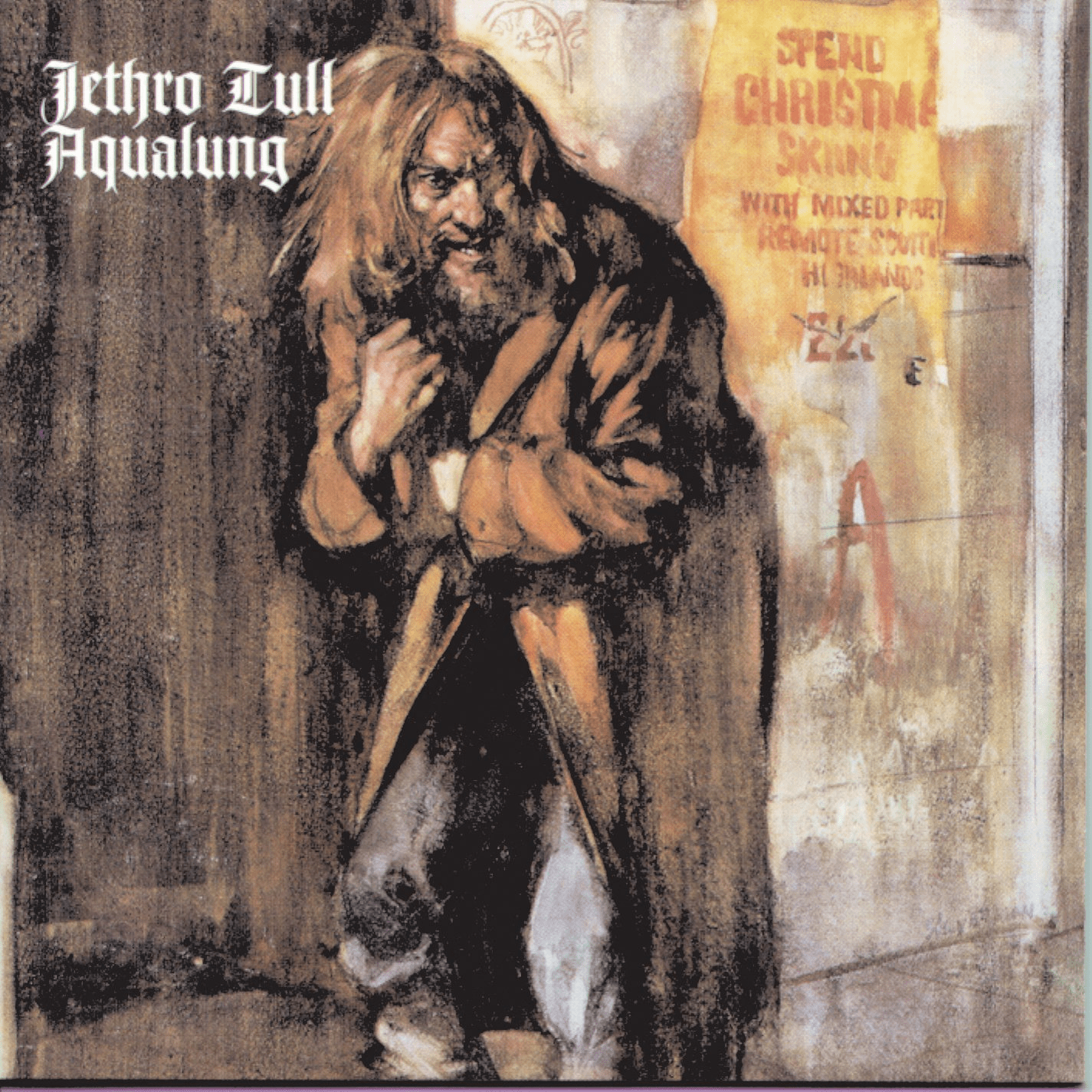
Most notably, he used plate bristol so that the colors slide around more and take longer to sink into the paper, so he was able to mash the paint around and even nearly erase parts of the painting. He didn’t worry all that much about having smooth color transitions.
I’d never heard of anyone using that paper for watercolor so I was curious to try Silverman’s techniques. I didn’t have any plate bristol handy but I had some bristol smooth paper, which is probably comparable in a pinch, but much more prone to warping. The elderly man below is the result of the experiment – it’s definitely a different approach to applying paint.
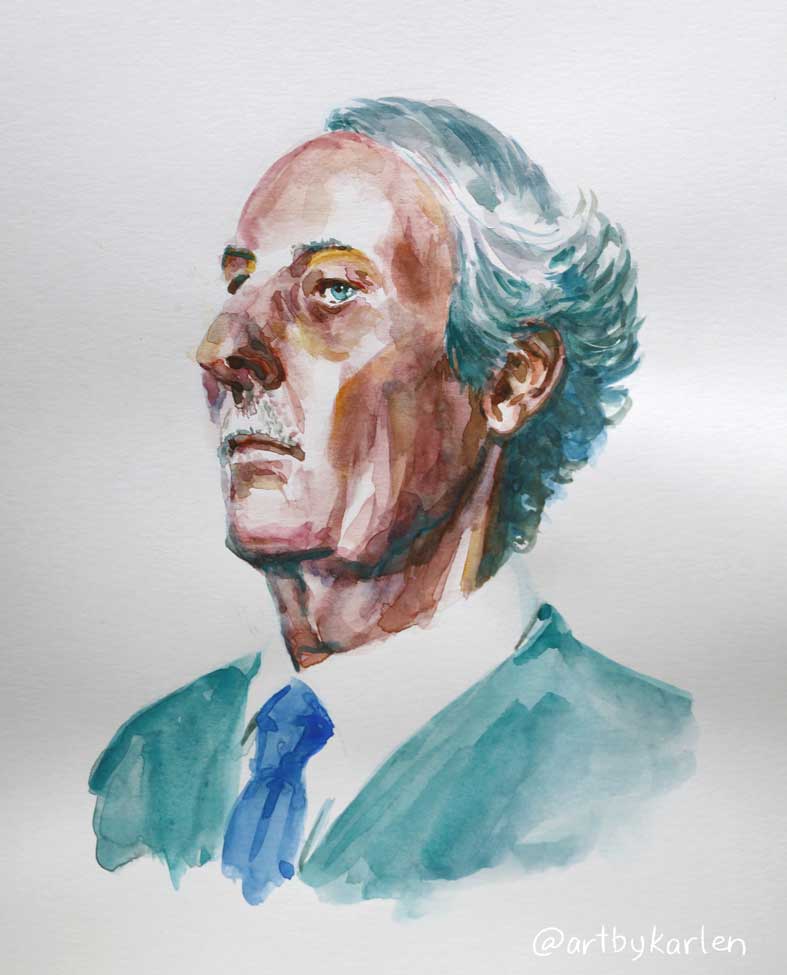
Besides the painting demos, I enjoyed Silverman’s philosophy and insights about the creative process – that there’s no correct way to do it. Since I have a ways to go with watercolor though, I should learn the rules before breaking them, so I went back to painting the “regular” way. I’d be mostly satisfied with this gentleman’s portrait if only his ear and jowls were less yellow. Maybe painting old people is more forgiving because they are allowed to have blotchy skin. But the bigger lesson is to be forgiving about making crappy paintings don’t go anywhere.
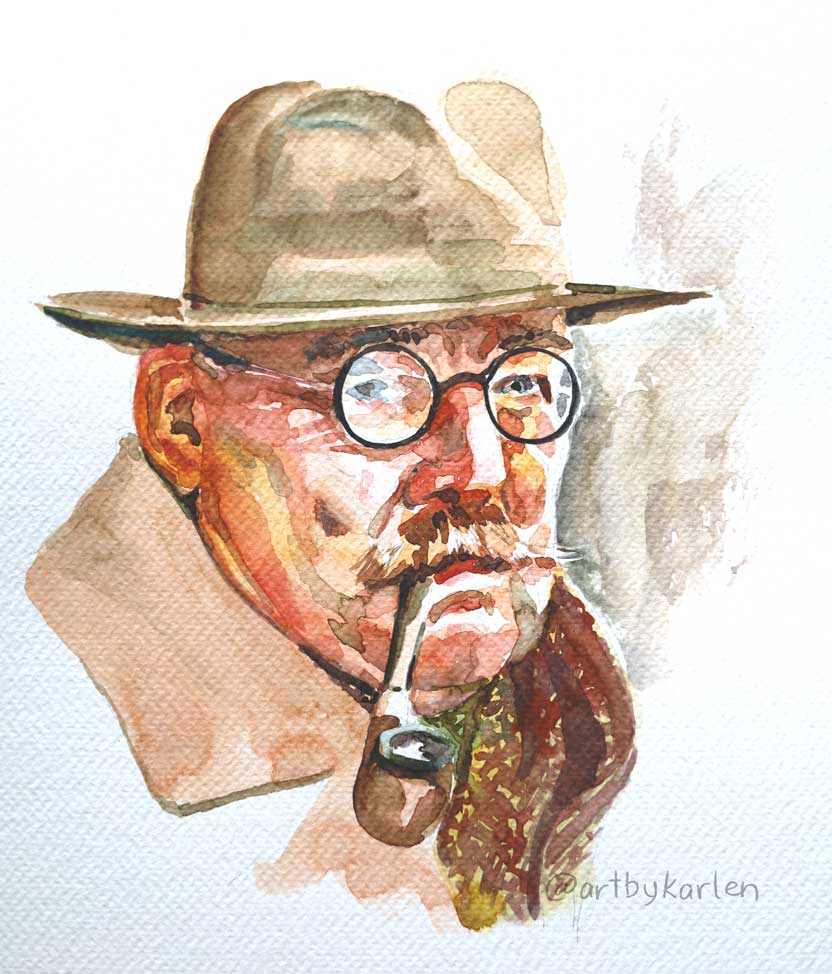
After a ton more practice, my goal is to be able to sketch, ideate, and finally produce polished illustrations in watercolor or even mixed media, as complex as some of my digital paintings. I also realize that trying to recreate my digital artwork with human hands and pigmented water may be counterproductive. I may end up redefining my “style” though I don’t think I have one so I might be spared from that impending existential crisis. I will still make digital art though, as it’s the fastest way to get a finished piece. I’m just less inclined to do so these days after endless hours working on a screen. For better or worse, I am grateful to be able to work at home, drawing for a living while I can. I don’t need to touch grass I need to touch paint.
At the risk of making this post too long, I leave you with this quote to ponder.
A work of art is the unique result of a unique temperament. Its beauty comes from the fact that the author is what he is. It has nothing to do with the fact that other people want what they want. Indeed, the moment that an artist takes notice of what other people want, and tries to supply the demand he ceases to be an artist, and becomes a dull or amusing craftsman, an honest or a dishonest tradesman. He has no further claim to be considered as an artist. -Oscar Wilde
Thank you for reading.
You may reply to this email directly if you don’t want to leave a public comment :)
Discover more from Art by Karlen
Subscribe to get the latest posts sent to your email.
 Art by Karlen